
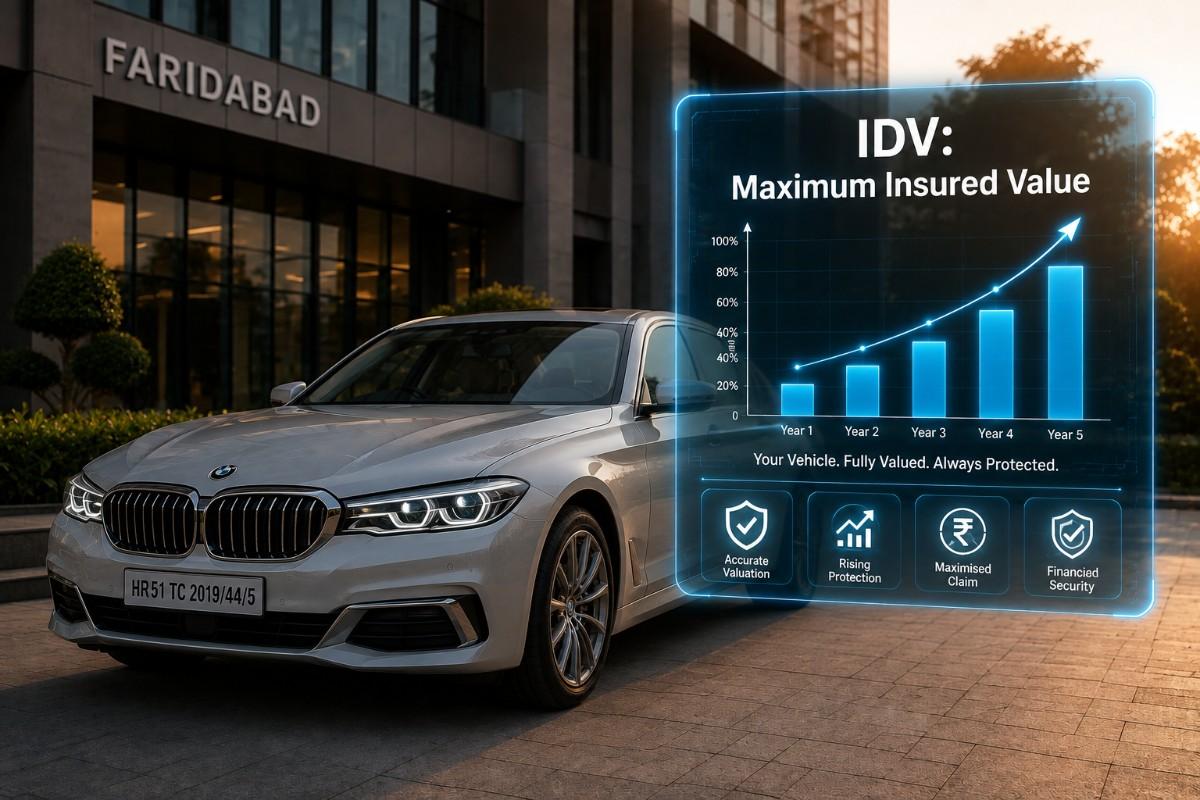
When you buy or renew your motor policy, you will frequently see a specific three-letter acronym on your documentation: IDV. Many car owners simply ignore this figure, focusing only on the final premium cost. However, misunderstanding this single metric can cost you lakhs of rupees in the event of a severe accident or vehicle theft.
When securing the best car insurance, your primary goal is robust financial protection. To achieve that, you must master what Insured Declared Value (IDV) is and how it dictates both your policy cost and your final claim payout.
What is IDV in Car Insurance?
Direct Answer for Vehicle Owners: Insured Declared Value (IDV) is the maximum sum assured fixed by the insurance company that is provided on the theft or total loss of a vehicle. Essentially, it represents the current market value of your car. IDV is calculated based on the manufacturer’s listed selling price of the brand-new vehicle minus the standard depreciation value based on the car’s exact age.
How is IDV Calculated? (The Depreciation Schedule)
The Insurance Regulatory and Development Authority of India (IRDAI) mandates a strict depreciation schedule that insurers must follow to determine your car’s IDV. As your car ages, its market value drops, and consequently, its IDV decreases.
Here is the standard IRDAI depreciation schedule used for premium calculation:
| Age of the Vehicle | Standard Depreciation % |
|---|---|
| Up to 6 Months | 5% |
| 6 Months to 1 Year | 15% |
| 1 Year to 2 Years | 20% |
| 2 Years to 3 Years | 30% |
| 3 Years to 4 Years | 40% |
| 4 Years to 5 Years | 50% |
Note: If your vehicle is over 5 years old, the IDV is mutually agreed upon between you and the insurer, usually determined by the condition of the car and current market resale values.
The Relationship Between IDV and Your Premium
Your IDV directly influences your policy’s premium. It is a simple, direct correlation: A higher IDV results in a higher premium, while a lower IDV results in a lower premium.
Because the “Own Damage” component of your premium is calculated as a percentage of the IDV, many online portals allow you to manually drag a slider to lower your IDV. This makes the premium look artificially cheaper and more attractive. However, this is a dangerous trap.
The Dangers of Artificially Lowering Your IDV
Imagine you own a car that is currently worth ₹10 Lakhs in the open market. To save ₹2,000 on your yearly premium, you adjust the IDV down to ₹7 Lakhs.
Six months later, the car is stolen, or completely destroyed in a heavy highway collision (a Total Loss scenario). The insurance company will only pay you the declared IDV of ₹7 Lakhs. You have essentially lost ₹3 Lakhs just to save a few thousand rupees on your premium. Always ensure your IDV accurately reflects the true market replacement cost of the vehicle.
Want to Know the Correct IDV for Your Car?
Stop guessing with online sliders. Speak to our local experts in Faridabad to get accurate vehicle insurance quotes based on the true market value of your car.
Calculate Your Exact Premium