
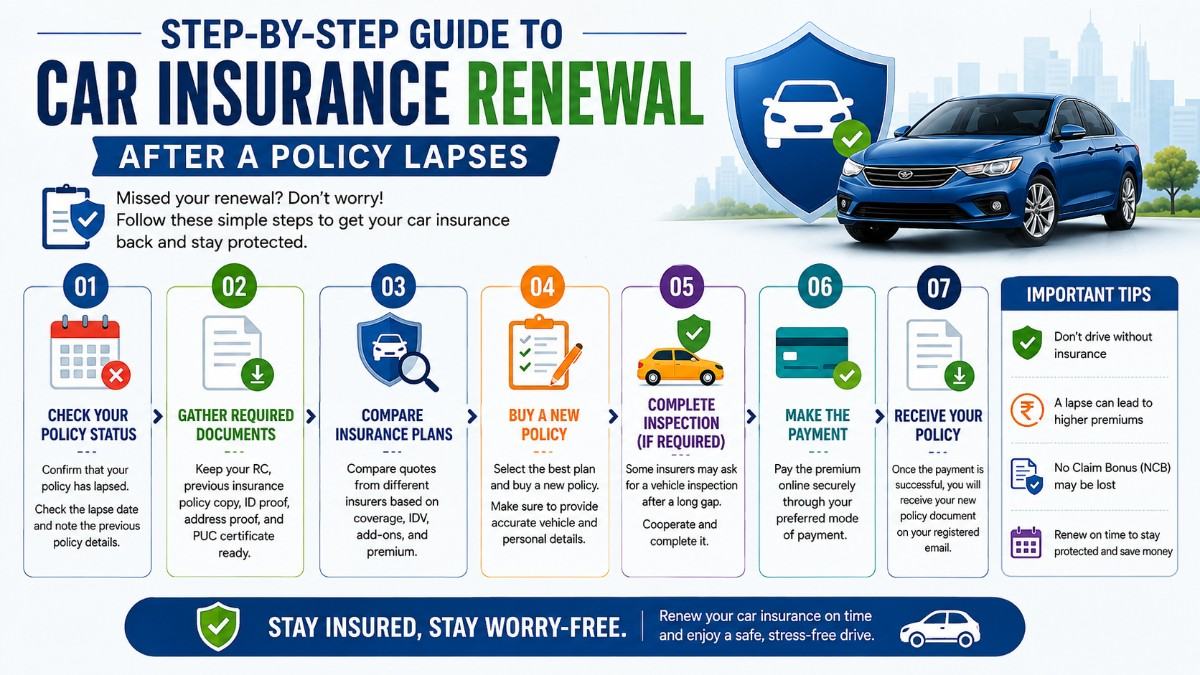
Discovering that your vehicle’s insurance has expired can induce a moment of panic. An expired policy means you are legally prohibited from driving on Indian roads, and your vehicle is entirely unprotected against accidents, theft, or natural disasters. The longer you wait to fix the situation, the more complicated the reinstatement process becomes.
Fortunately, restoring your coverage is a straightforward process if handled correctly. To ensure your car insurance renewal goes smoothly—without unnecessarily inflating your premium—follow this complete, step-by-step guide.
What to Do When Your Policy Lapses
If your car insurance expires, you must first stop driving the vehicle immediately to avoid legal penalties. Next, gather your Registration Certificate (RC) and the expired policy document. You will then need to contact an insurance provider to schedule a vehicle inspection (either physical or self-video). Once the inspection clears and proves there are no pre-existing damages, you can pay the premium to instantly reinstate your comprehensive coverage.
Step 1: Stop Driving Your Vehicle Immediately
The moment your policy crosses midnight on its expiry date, you lose all Third-Party Liability and Own Damage coverage. Driving without valid insurance violates the Motor Vehicles Act, which can result in an immediate fine of ₹2,000 for the first offense and up to ₹4,000 for subsequent offenses in Haryana.
Worse, if you cause an accident while driving an uninsured vehicle, you are personally liable for all medical bills and property damage costs incurred by the third party.
Step 2: Keep Your Documents Ready
To speed up the reinstatement process, have the following details and documents handy before you contact an agent or log into a portal:
- Your vehicle’s Registration Certificate (RC).
- A copy of your recently expired insurance policy (to verify your accumulated No Claim Bonus).
- Your standard KYC documents (Aadhaar or PAN card).
Step 3: Prepare for the Vehicle Inspection
If your comprehensive policy has expired, insurance companies will not blindly reinstate it. They must ensure the vehicle hasn’t been in an accident during the uninsured period.
Depending on how long the policy has been expired, you will face one of two scenarios:
| Lapse Duration | Inspection Requirement |
|---|---|
| 1 to 90 Days Expired | Usually requires a quick Digital Self-Inspection. You upload a 360-degree video of the car using an insurer’s mobile app. It is approved within a few hours. |
| Over 90 Days Expired | Typically requires a Physical Surveyor Inspection. An agent visits your home to inspect the car for pre-existing dents or damages. |
Pro Tip: If you only need mandatory Third-Party Liability cover (no Own Damage protection), you can often secure a no inspection renewal. However, we strongly advise against dropping comprehensive coverage.
Step 4: Check Your NCB Status
Your No Claim Bonus (NCB) is your most valuable discount. If your policy has been expired for less than 90 days, your accumulated NCB is completely safe. Ensure the agent applies this discount to your new premium quote.
If the policy has been expired for more than 90 days, you lose your NCB entirely, and your premium will be calculated from a 0% discount base.
Step 5: Compare Quotes and Complete the Payment
A policy lapse is the perfect time to evaluate if you are getting the best deal. Ask your local agent to compare quotes from multiple IRDAI-approved insurers based on the correct Insured Declared Value (IDV). Once the inspection clears and you are satisfied with the quote, pay the premium online.
As soon as the payment goes through, you will receive a digital copy of your policy via email, giving you an instant vehicle renewal so you can legally get back on the road.
Has Your Policy Already Expired?
Don’t navigate the complex inspection process alone. Contact Faridabad Insurance Wala today. We will guide you through the digital inspection and reinstate your comprehensive coverage effortlessly.
Reinstate Your Policy Today