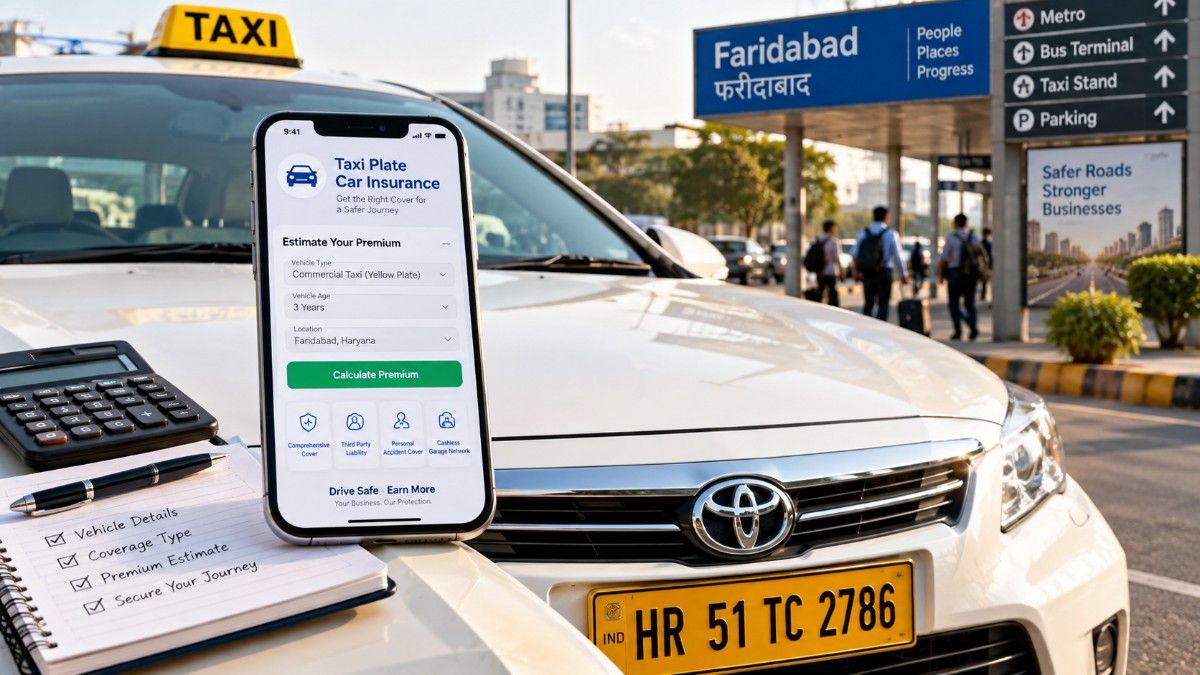
Operating a passenger-carrying vehicle in India comes with a strict set of commercial liabilities. If you are registering a vehicle for Ola, Uber, or a private travel agency in Faridabad, you cannot simply purchase a standard private car policy. To operate legally, you must secure a dedicated commercial passenger policy.
Many first-time operators are surprised by the final taxi plate car insurance price because commercial underwriting involves specific passenger liabilities and commercial risk tariffs. Understanding exactly how your premium is calculated allows you to make informed decisions and avoid overpaying for coverage.
Commercial Taxi Premium Calculation
How is the Taxi Insurance Premium Calculated?
- Base Third-Party (TP) Rate: Determined purely by the vehicle’s engine cubic capacity (CC). For commercial vehicles, this rate is significantly higher than private cars.
- Legal Liability to Passengers (LLP): A mandatory per-seat charge based on the vehicle’s licensed passenger capacity (excluding the driver).
- Own Damage (OD) Premium: Calculated as a percentage of the vehicle’s Insured Declared Value (IDV). Insurers often apply commercial loading (a risk surcharge) based on the city of operation.
- CNG/LPG Endorsements: Taxis retrofitted with external CNG kits require an additional premium (usually a percentage of the kit’s value) to cover fire risks.
The Core Components of Your Taxi Premium
Unlike a private car, a yellow-plate vehicle’s premium structure is heavily weighted toward passenger safety. Let us break down the exact elements that make up your final commercial car insurance quote.
1. IRDAI Fixed Third-Party (TP) Tariffs
The base Third-Party liability premium is non-negotiable and set annually by the Insurance Regulatory and Development Authority of India (IRDAI). It is categorized by engine capacity. Here are the latest standard rates for four-wheeled passenger vehicles (up to 6 passengers):
| Engine Capacity (CC) | Base TP Premium | Common Taxi Models |
|---|---|---|
| Up to 1000 CC | ₹6,040 | Maruti Alto, Celerio |
| 1001 CC to 1500 CC | ₹7,940 | Swift Dzire, WagonR, Hyundai Aura |
| Above 1500 CC | ₹10,523 | Toyota Innova, Ertiga |
2. Legal Liability to Passengers (LLP)
This is where commercial taxi insurance differs significantly from private insurance. Because you are transporting paying customers, you must purchase a mandatory passenger liability cover. The IRDAI charges this strictly on a “per licensed passenger” basis.
- For 1001 to 1500 CC vehicles: The charge is roughly ₹978 per licensed passenger.
- Calculation: For a standard 4-passenger Swift Dzire cab, you multiply ₹978 × 4 = ₹3,912. This amount is added directly to your base TP premium.
3. Own Damage (OD) Cover & Commercial Loading
While the TP rates are fixed by the government, the Own Damage premium—which covers accidents, theft, and natural disasters to your actual vehicle—is decided by the insurance company. It is calculated as a percentage of your IDV (market value). Because taxis spend upwards of 12 hours a day in traffic, insurers apply a “commercial risk loading” factor, making the OD premium higher than a private car of the same value.
The Impact of CNG on Your Premium
In Delhi-NCR and Haryana, almost all commercial hatchbacks and sedans operate on CNG. If your vehicle has an externally retrofitted CNG kit (not company-fitted), you must declare it to the insurer.
The insurer will charge an additional OD premium (usually 4% to 5% of the CNG kit’s declared value) and a mandatory flat TP surcharge for the bi-fuel system. Failing to endorse the CNG kit on your policy will result in an immediate claim rejection if the vehicle catches fire or suffers an accident.
Need an Exact Quote for Your Taxi?
Do not guess your premium based on outdated tables. Request a custom commercial car insurance quote for your fleet at Faridabad Insurance Wala and ensure you are fully compliant with passenger liability laws.
Get Your Custom Taxi Quote