Every two-wheeler owner in India is required to hold active insurance to ride legally on public roads. However, when purchasing or renewing a policy, vehicle owners are frequently confused by industry terminology like “first-party cover,” “third-party cover,” and “comprehensive protection.”
Choosing the incorrect plan can leave you liable for massive mechanical repair bills after a road incident. When evaluating trusted bike insurance, understanding the legal and financial boundaries between these two policy types ensures you never face unexpected out-of-pocket expenses. At Faridabad Insurance Wala, we believe in breaking down these policies clearly so you can make the smartest choice for your motorcycle or scooter.
The Fundamental Difference: 1st Party vs 3rd Party
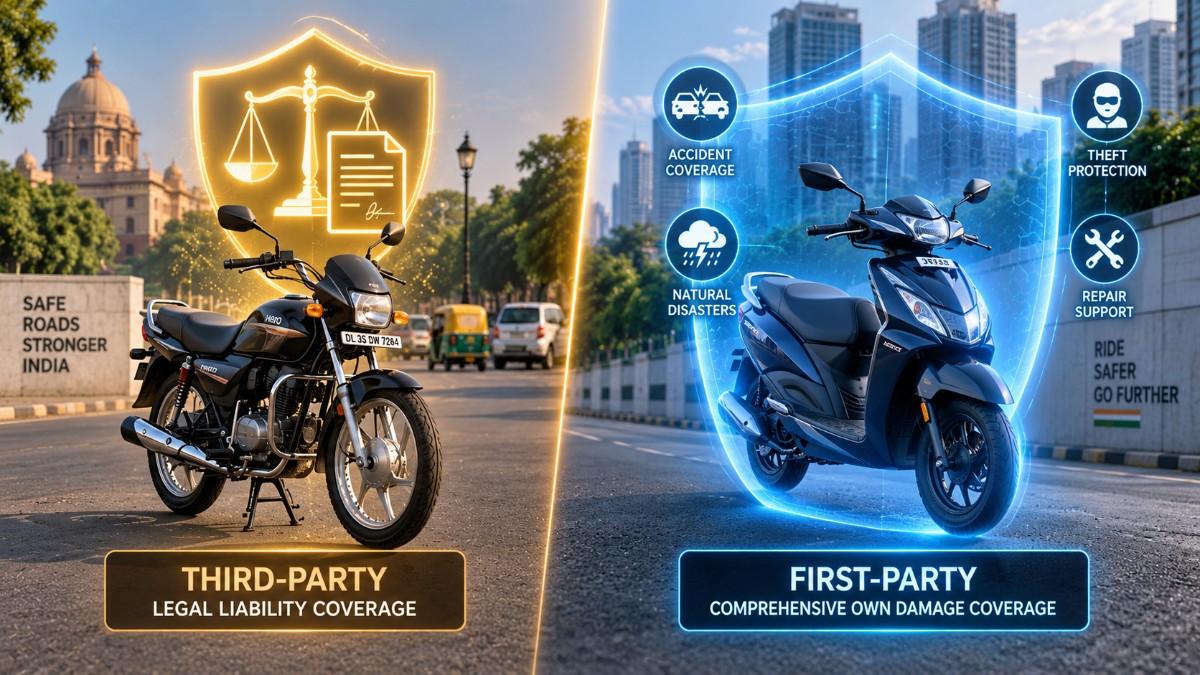
The exact difference between bike insurance 1st party vs 3rd party lies in who receives the financial claim payout. A Third-Party Policy only covers your legal liabilities for death, bodily injury, or property damage caused to another individual by your two-wheeler; it pays zero rupees for damages to your own bike. A First-Party Policy (also known as Comprehensive or Own Damage) covers your personal motorcycle against accidents, theft, fire, and flood damage, while simultaneously incorporating the mandatory third-party liability coverage.
Understanding the Parties in Motor Insurance
To make sense of the terminology, you need to understand who the “parties” are in an insurance contract:
- First Party: You (the policyholder and registered vehicle owner).
- Second Party: The insurance company providing the financial coverage.
- Third Party: Any other individual, vehicle, or public property affected by an accident involving your two-wheeler.
Detailed Side-by-Side Comparison
To help you decide which two-wheeler policy suits your lifestyle, review this direct comparison:
| Coverage Parameter | 3rd Party Insurance | 1st Party (Comprehensive) Insurance |
|---|---|---|
| Legal Requirement | Mandatory under the Motor Vehicles Act. | Includes the mandatory cover plus optional asset protection. |
| Damage to Your Own Bike | Zero payout. You pay 100% of the workshop bills. | Insurer covers repair costs up to the Insured Declared Value (IDV). |
| Vehicle Theft / Total Loss | Not covered under any circumstance. | Full IDV payout upon confirmation of non-recovery by police. |
| Add-On Eligibility | Cannot attach add-ons. | Eligible for Zero Dep, Engine Protect, and Roadside Assistance. |
| Premium Determination | Fixed tariff established annually by IRDAI based on engine cc. | Calculated based on vehicle age, cubic capacity, and declared market IDV. |
Which Policy Should You Purchase?
If you ride a daily commuter motorcycle, a premium sports bike, or a modern electric scooter, opting for a first-party (comprehensive) plan is an absolute necessity. The modest increase in your annual premium easily pays for itself with just a single repair claim or unfortunate incident.
Standalone third-party insurance is generally advisable only when your two-wheeler has exceeded its operational lifespan (e.g., 10-15 years old), retains negligible market resale value, and operates purely on localized, low-speed errands.
Verify Your Two-Wheeler Coverage Today
Are you unsure if your current policy includes 1st-party damage protection or just basic 3rd-party legal liability? Contact Faridabad Insurance Wala for a quick policy review and a competitive quote across India’s top insurers.
Check Your Bike Policy Details